OpenID Connect (OIDC) is an identity layer built on top of OAuth 2.0. It adds authentication to the authorization capabilities of OAuth, allowing applications not only to obtain access tokens, but also to verify a user’s identity and retrieve basic profile information.
When integrating with TrustBuilder using OIDC, your application can authenticate users through the Authorization Server and receive an ID Token containing identity claims about the user (e.g. name, email, unique ID). This ID Token is a signed JWT that allows your application to verify who the user is.
Set up an OIDC-based integration
-
Log in to the Admin Portal.
-
Go to Integrations > Applications > + Set up app integration.
-
Select OIDC.
-
In General section, fill in the fields:
|
Parameter |
Description |
|---|---|
|
Name |
Give your application a clear and descriptive name. This name will appear in the applications list and on authentication pages. |
|
Description |
(Optional) Add a short description for your application. |
|
Logo |
Upload an image file. The logo will be visible in the applications list and on the authentication pages. |
-
Choose the Application Type.
It determines how the application communicates with the Authorization Server and whether it can securely store secrets.-
Regular Web App: for traditional web applications (e.g., HTML, CSS, JavaScript) running on a secure backend. This type uses the Authorization Code flow and requires a client secret, which is securely stored on the server.
-
Public Application: for Single Page Applications (SPA), mobile apps and browser-based applications. Since it cannot securely store secrets, it uses the Authorization Code flow with PKCE (Proof Key for Code Exchange) enabled by default to prevent authorization code interception attacks. Choose this if your app runs in an environment where storing secrets securely is not possible.
-
Transaction confirmation: for applications that need the user to approve sensitive actions, like payments or high-risk changes. When a transaction starts, the user must confirm it before it is processed.
-
-
Click on Next.
-
Fill in the mandatory fields:
The parameters differ depending on the application type chosen.
|
Parameter |
Description |
|---|---|
|
Subject Management |
Select the user attribute that uniquely identifies the user. This value will be used as the
|
|
API & Scopes |
Select which APIs (resource servers) your application can access, and the scopes (permissions) it is allowed to request.
|
|
Client Authentication method |
Choose how your application authenticates to the Authorization Server when exchanging the authorization code for tokens. This step, called client authentication, ensures that the request comes from a trusted application and not from a malicious source.
|
|
Redirect URIs |
|
|
Policies |
Select the authorization policy that defines the access rules for this application. If not created click on Create a new authorization policy. More information |
|
Access Token |
An access token is a signed JWT that allows an application to access protected resources on behalf of a user. Select the JWT signature algorithm used to sign the token:
|
|
Backchannel settings |
Enter the URL where your application will receive authentication responses and tokens. When a user approves or rejects a transaction, the IdP sends the result to this endpoint.
|
-
Click on Submit.
-
For Regular web-app and Transaction confirmation
Copy the client secret from the pop-up.
⚠️ It will not be displayed again for security reasons. To revoke and generate a new client secret, see Revoke client secret below.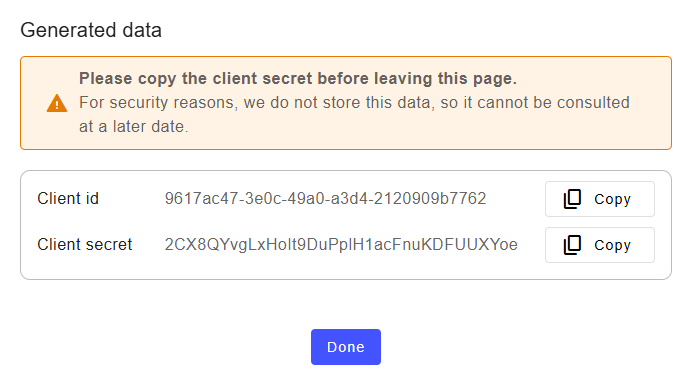
-
Click on Done.
The main configuration is complete. -
You can now configure your application in more detail.
|
Tab and parameter |
Description |
|---|---|
|
SECURITY SETTINGS |
|
|
Authorization Code Lifetime
|
Set the validity period of the authorization code (in seconds). The authorization code is issued after the Resource Owner's authentication and is used by the application to request access tokens. Default: 60 seconds. |
|
Access Token Lifetime |
Set the validity period of the access token (in seconds). The access token is a signed JWT allowing the app to access protected resources on behalf of the user. Default: 900 seconds. |
|
Certificate |
Select the certificate that secures OIDC token exchanges with your application, ensuring integrity and confidentiality. |
|
ID Token lifetime |
Set the validity period of the ID token (in seconds). The ID token is issued by the Identity Provider and contains information about the authenticated user's identity. Default: 86400 seconds (24 hours). |
|
Refresh Token |
Set the validity period of the refresh token (in seconds). This token allows the application to obtain new access tokens without requiring the user to re-authenticate. Default: 86400 seconds (24 hours). Refresh tokens can also be disabled (enabled by default). |
|
Allowed Origins |
Enter the URLs or domains authorized to initiate authentication requests to the Identity Provider. This helps protect against unauthorized interception or redirection attacks. It is not recommended to use |
|
Backchannel logout |
Specify the URI where the application receives logout tokens directly from TrustBuilder to terminate the user's session.
|
|
APIS & SCOPES |
|
|
OpenID Connect (OIDC) settings |
Standard OIDC scopes are supported automatically, no need to add them. Use this parameter only for custom scopes. To add a custom scope:
|
|
APP SETTINGS |
|
|
Consent Management |
Define how user consent is handled regarding their personal data.
|
-
In Endpoints tab, you can copy the various endpoints:
-
OIDC User Info: URL to retrieve user profile information after authentication.
-
OAuth Authorization: Endpoint to initiate the OAuth authorization process (user login and consent).
-
OIDC Back Channel Authorization: endpoint used in the Transaction Confirmation (CIBA) flow. Your application receives authentication requests here and the IdP sends the user’s approval or rejection response and tokens to the Client Notification Endpoint.
-
OAuth Token: Endpoint to exchange an authorization code for access and refresh tokens.
-
OAuth Introspection: Endpoint to validate and inspect the status and metadata of an access token.
-
OAuth Revocation: Endpoint to revoke access or refresh tokens, invalidating them.
-
OAuth JWKS (JSON Web Key Set): Endpoint providing the public keys used to verify JWT signatures issued by the server.
-
Well-Known URL: Metadata endpoint providing standard discovery information about the OAuth/OIDC server configuration.
-
Revoke a client secret
At any time you can revoke a client secret. A new client secret will be genereated and display.
Be careful when you revoke your client secret, you must change it in all applications and you will no longer be able to log in with it.
To revoke a client secret:
-
Navigate to Access Management > Applications.
-
Click on your application.
-
Go to Credentials tab.
-
Click on Revoke.

-
Click on Revoke to confirme the action.
It cannot be undone.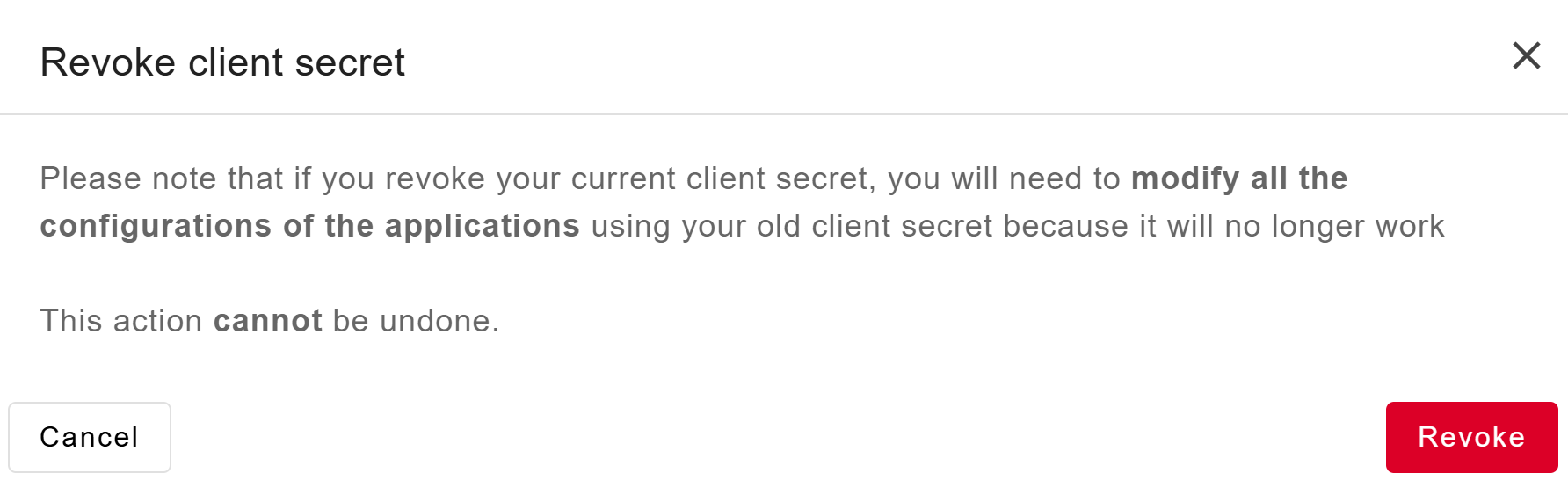
The client secret is successfully revoked. A new one has been generated. Copy it as it will not be shown again for security reasons.